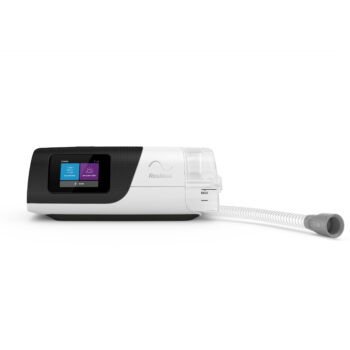
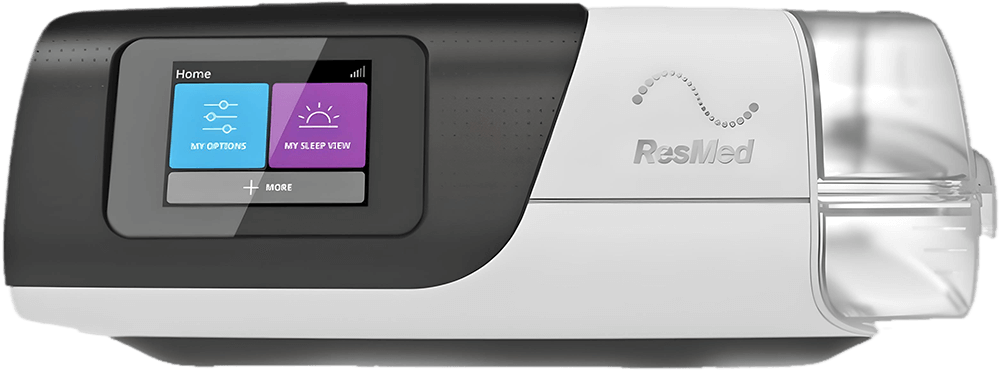
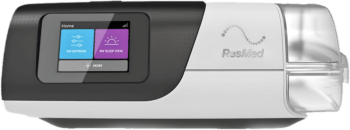
Resmed VPAP™
Adapt SV
The right support at the
right time—adapting
breath-by-breath
VPAP Adapt SV™ is an adaptive
servo-ventilator designed
specifically to treat central
sleep apnea (CSA) in all its
forms, including complex and
mixed sleep apnea.
Unlike
conventional sleep-disordered
breathing (SDB) therapies such
as continuous positive airway
pressure (CPAP), adaptive
servo-ventilation:
- treats complex sleep apnea
syndrome and central sleep
apnea
- normalizes breathing,
completely suppressing CSA
and/or Cheyne-Stokes
respiration (CSR)2,3
- improves sleep
architecture2
(the amount of time the
patient spends in slow-wave
and REM sleep increases).
Peer-reviewed literature
shows that adaptive
servo-ventilation:
- enhances quality of life
for patients with CSA3,4.
Support when it's
needed
The adaptive
servo-ventilation algorithm:
- adapts to the patient’s
ventilatory needs on a
breath-by-breath basis
- automatically calculates a
target ventilation (90% of the
patient's recent average
ventilation)
- adjusts the pressure
support to achieve it.
Maximizing patient
comfort and compliance
- ensures pressure support
is synchronized to the
patient's own recent breathing
rate and flow pattern
- provides a constant, low
level of pressure support.
Three advantages to
give your patients a smooth
start to therapy
Setting a new standard in
quiet and comfortable therapy,
ResMed’s VPAP™ series of bilevel
devices has four innovative
features that can help improve
your patients’ likelihood of
long-term compliance.
Better humidification
- The HumidAire 2i™ heated
humidifier offers relief from
common side effects of therapy
such as dry throat and nasal
congestion, improving patient
comfort and overall compliance.
Able to integrate fully with the
VPAP III ST-A and VPAP Adapt SV,
the HumidAire 2i is designed for
easy attachment and detachment
to suit variations in therapy
requirements and seasons.
Smooth Easy-Breathe
waveform - The smooth
waveform mimics the patient’s
breath pattern so breathing
feels more natural.
Platinum Service
guarantee - Our
superior bilevels are backed by
ResMed’s Platinum Service
program, which guarantees a
brand new replacement if your
bilevel ever needs servicing.
Specifications:
Dimensions (H x W x
D)
5.6" x 9.8" x 11.5"
(142 mm x 248 mm x 293 mm)
Weight
Flow generator with
cover: 8.14 lbs (3.7 kg) Flow generator with HumidAire 2i
(empty): 9.24 lbs (4.2 kg)
Environmental
conditions
Operating
temperature: 41ºF
to 95ºF (+5ºC to +35ºC)
Storage and
transport temperature:
-4ºF to +140ºF (-20ºC to +60ºC)
Humidity—operating,
storage and transportation:
10%–95% non-condensing
Housing
construction:
Injection moulded plastic
Air tubing:
1 x 6’6” (2 m)
Air filter:
Synthetic fiber
Patient connection
port: 22 mm
taper, compatible with ISO 5356-1:2004 Anaesthetic & Respiratory
Equipment—Conical
Connectors
Power supply
AC Input range:
110–120V and 220–240V;
50–60Hz; 60VA
DC Input range (if
using DC Converter:
12–13.8V DC
Performance
Operating pressure
range: 4–25 cm
H2O
Sound pressure
level
<30 dBA (tested in
accordance with the requirements of ISO 17510-1)
Battery type:
Lithium 34
Alarm
specifications
High maximum mask pressure
alarm
Stops air delivery
at 30 cm H2O >700 msec.
Stops air delivery
when mean mask pressure exceeds 22 cm H2O (averaged over approx
1 minute).
Mask pressure is
less than 3 cm H2O for longer than 5 seconds while the patient
is using the VPAP Adapt SV.
Is triggered if for
3 breaths in a row the maximum mask pressure achieved at
inspiratory to expiratory transition is either <87.5% of the
absolute mask pressure targeted at that point, or < absolute
mask pressure targeted minus 1 cm H2O, whichever is the lower.
High leak alarm
Leak exceeds 30
L/min for more than 20 seconds.
Flow is less than 6
L/min for more than 20 seconds.
IEC 601-1
classifications
Class II, Type CF
Class II medical
electrical equipment provides protection against electric shock
either by double insulation or reinforced insulation and does
not require a protective earth.
Inspiratory Trigger
Characteristics
The inspiratory
trigger occurs at a flow greater than 0 LPM when tested with
EPAP=5 cm H2O, IPAP=15 cm H2O, sinisoidal breath shape. The
inspiratory trigger response time is <600 ms when tested with
EPAP=5 cm H2O, IPAP=15 cm H2O, 0.67 L/sec inspiratory and
expiratory flow rate. The time is measured from the beginning of
inspiratory flow to the beginning of pressure rise to IPAP.
|