Frequently Asked Questions Regarding the XPO2
Q1. Can the XPO2 be used at night?
A. Yes, it can be used at night IF the patient has been titrated to ensure he/she can trigger the conserver and stay oxygenated. An overnight titration or titration at exercise should result in an appropriate setting to maintain oxygen saturation
Q2. What length of cannula should be used?
A. The length of a single lumen cannula can be from 4 ft. to 25 ft. It is recommended that the patient be titrated on the length of cannula that will actually be used.
Q3. Can the XPO2 be used with a humidifier?
A. No, a humidifier cannot be used because it will interfere with the conserver sensitivity. Because oxygen is only being delivered on inspiration, the need for additional humidity is not as great as with continuous flow.
Q4. Can the XPO2 be used with CPAP?
A. No, it cannot be used with CPAP or any PAP device because it will interfere with the conserver. A patient using CPAP that requires oxygen should use a concentrator with continuous flow.
Q5. When using the supplemental battery, does the unit draw from the internal battery first?
A. No. When the supplemental battery is used, the unit will draw from the battery that has the most charge. It uses the batteries in conjunction with each other to maximize efficiency.
Q6. Can you connect more than one supplemental battery at a time?
A. No. Only one supplemental battery can be used at a time.
Q7. How long will the battery last?
A. A fully charged battery will last approximately 2.5 hours on setting 2. The life cycle of the battery is approximately 18 months or 250-300 charges.
Q8. How much lithium is contained in the battery?
A. The internal and external batteries each contain a total amount of lithium of 6.24 grams. This relates to the most recent regulations for the use of lithium ion batteries on board aircraft that limits the total amount of lithium to 8 grams per pack.
Q9. What happens if the cable from the supplemental battery cord is plugged in to the port on the supplemental battery?
While this is not recommended, no damage will occur to the battery
Q10. How does the conserver compare to the EP5 on HomeFill?
A. The conservers are similar in sensitivity, but Invacare believes that the XPO2 conserver delivers a slightly larger bolus more quickly than the EP5, according to Invacare’s internal testing of the XPO2 and third party information about the EP5. See the XPO2 PDOD FAQ for more details.
Q11. Is the XPO2 approved for use on airplanes?
A. We have submitted for FAA and airline approvals, but at this time the XPO2 is not approved for use onboard a plane. Patients may be able to take it on board (and not use it), but until we get authorization from the FAA and the specific airline, patients are advised to check with their airline before traveling. The XPO2 and any supplemental batteries may be permitted as carry-on baggage, but not in checked luggage; always check your airline’s regulations.
Q12. What’s the difference between XPO100 and XPO100B?
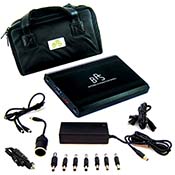
A. Only the XPO100B includes the supplemental battery and its carrying case. Both model numbers include the concentrator, carrying case, AC and DC adapters, accessory bag and Instructional DVD. If desired, a supplemental battery can be ordered separately under model number XPO110.
Q13. Where is the XPO2 manufactured?
A. The XPO2 is manufactured in the Invacare Respiratory Manufacturing facility in Sanford, FL.
Q14. Will the XPO2 function at high altitudes?
A. Yes, the unit was designed to function up to 10,000 ft. It will automatically adjust to changes in altitude.
Q15. Can the XPO2 be used while lying flat?
A. The unit should always be used in an upright position. Doing so will prevent water or other liquids from entering the unit.
Q16. What is the preventative maintenance schedule?
A. Oxygen purity should be checked every 4,320 hours. Gross particle and inlet filters should be changed as needed. Refer to the Owner’s Manual provided with the XPO2for complete information.
Q17. Is the XPO2 field serviceable?
A. Outside of routine maintenance and battery replacements, all units need to be returned to Invacare for repair. In addition, the compressor cannot be rebuilt. It must be returned to Invacare so we can diagnose the problem and return to the manufacturer for servicing.
Q18. What is not covered by the 5 year limited warranty?
A. The compressor is covered by a two-year limited warranty. The batteries (both internal and supplemental) are warranted for one year. Other accessories such as the AC or DC adapter are also warranted for one year.
Q19. What is the expected life of the compressor?
A. The compressor should last approximately 10,000 hours before maintenance is required.
Q20. What is the expected life of the battery?
A. Both the internal and external batteries will last approximately 250-300 charging cycles.
Q21. Does the XPO2 have an integrated oxygen sensor?
A. No; however, while the XPO2 does not have an oxygen sensor, it does monitor, and provide alarms for, parameters that would result in low purity such as compressor, leaks, flow, etc. While this is not a direct measurement of purity, it serves as an effective indirect method because typically low oxygen purity is a result of an issue somewhere in the core system and the alarm system can detect most such issues.
In addition, purity can be measured with a standard hand held analyzer. Simply set the unit to “auto pulse” mode, let it run for 5 minutes to warm up, then check the purity level. For the auto pulse setting, set the unit on “5”, then simultaneously press the “+” and battery check buttons until the blue #5 setting indicator blinks. The unit will remain in auto pulse until it is set to a lower flow or turned off. Complete instructions are included in the Service Manual.
Q23. Does Invacare have a program to support traveling patients in the event that an XPO2breaks down?
A. Yes. Invacare will work through the patients’ Provider to send a loaner unit directly to the patient. The Provider needs to contact customer service to arrange for this service, as well as to return the broken unit for warranty replacement or repair.
Product Specifications
-
Oxygen flow Pulse Dose Delivery, Settings 1-5
-
Oxygen concentration 90% +/- 3% at all settings
-
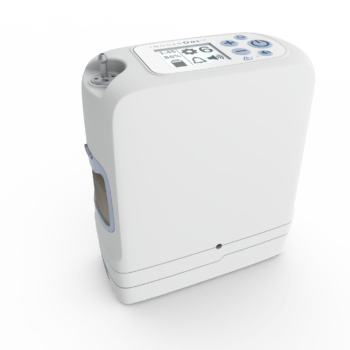
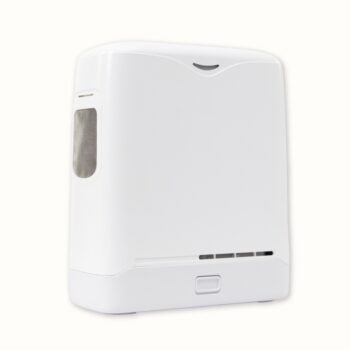
Weight 6 pound concentrator, 1.3 pounds supplemental battery
-
Dimensions 10" H x 7" W x 4" D
-
Battery duration 2.5 hours at setting 2, internal battery
-
2.5 hours at setting 2, supplemental battery
-
Battery recharge time 3 hours*
-
Power consumption 35 watts
-
AC power adapter 100-240 VAC 50/60 Hz, 1.5 amps at 120 VAC
-
DC power adapter 12-16 VDC, 3.3 amps at 18 VDC
-
Operating altitude Up to 10,000 ft (3046 m) above sea level
-
Oxygen capacity 900 ml per minute
-
Concentrator limited warranty 5 years
-
Battery limited warranty 1 year
-
Wheeled cart and accessory bag.
Features
Patient Benefits
-
Small, lightweight and inconspicuous
-
Designed for ease of use
-
No more fear about running out of oxygen
-
Encourages mobility, travel and independence
-
Easy to understand control panel for simple operation